
Today, we’re excited to share details about a rare and fascinating coat color coming to V2: mushroom!
What is Mushroom?
Mushroom is a coat color found exclusively in Shetland ponies in real life. It affects red pigment only and effectively makes the horse look sepia-toned or bleached out, like this chestnut mushroom:
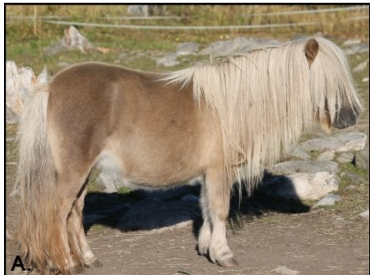
Mushroom wasn’t included in V1 because the mutation is so rare in real life that we didn’t have many examples of how mushroom interacts with other dilution combinations. After more research, though, we’ve found enough examples of how the color affects single cream and dun dilutions to confidently add it to V2!
The Genetics
A recent study pinpointed a frameshift mutation* in the gene MFSD12, which is expressed in melanocytes (pigment cells), as the likely cause of mushroom. It’s a recessive trait, meaning horses must be mu/mu in order to express mushroom.
How Mushroom Works
There are a couple of interesting quirks about the mushroom color:
It doesn’t affect black pigment. So E- a/a mu/mu horses will just be black.
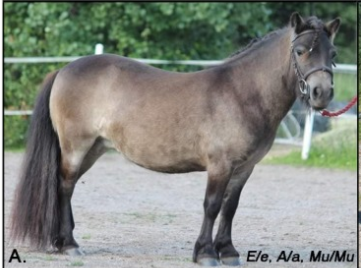
It does affect the red portions of bay horses, making those areas more sepia-toned, like this:
Oh, and since this color is testable in real life, it will be testable in V2 as well!
*Extra Genetics Lesson: What’s a Frameshift Mutation?
Want to know what a frameshift mutation is? Excluding introns, the coding region of a gene is always in multiples of 3 bases, and those 3 bases make “codons,” which encode for specific amino acids.
For example, if this were a gene: ATGGCCTACAAGTAA, the codons would be:
ATG and GCC and TAC and AAG and TAA
The first codon is always a “start” codon and encodes for methionine, while the last codon is always a “stop” codon and doesn’t encode for anything. So this gene would make a 4-amino acid-long protein.
When you have mutations in a gene, there are a couple of main types, such as “in-frame” or “frameshift.”
In-frame mutations mean that one or more bases were swapped for another (except in the start or stop codon), or new bases were added in multiples of 3. Using the gene above, it could be something like:
ATGACCTACAAGTAA or ATGAAGGCCTACAAATAA
These kinds of mutations might produce a protein of the same length with a different amino acid, or they could produce a longer or shorter protein. (I say “might” because some codons are redundant, so a single nucleotide mutation doesn’t always change the amino acid.) The key here is that the final codon, the stop codon, is unchanged. Usually these types of mutations have smaller impacts on proteins.
For frameshift mutations, you actually have bases added in or deleted not in multiples of 3, which often shifts the location of the stop codon. For example:
If we deleted these bases in the gene above: ATGGCCTACAAGTAA
We would end up with: ATGGCCTAAGTAA
Now there’s a stop codon even earlier! So the gene would end up being shorter—only ATG then GCC before the first TAA, which is only 2 amino acids!Frameshifts often have big impacts on a gene, or at least on the protein it produces (though not always). In the case of the mushroom mutation, it actually results in a protein that has 277 amino acids less than the normal protein! A change that big is very likely to alter how a protein functions.